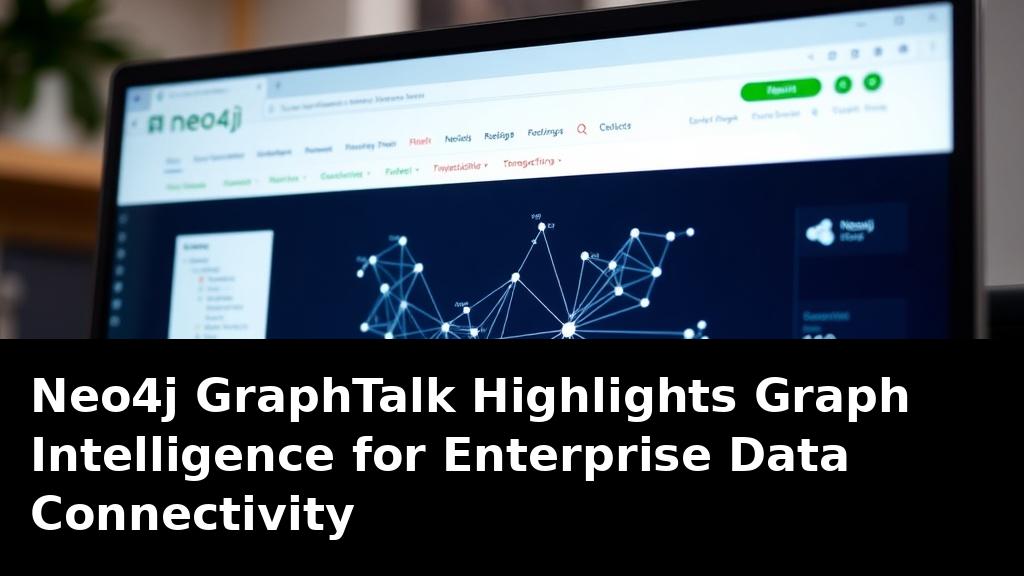
Graph databases have emerged as a critical technology for organizations seeking to maximize the value of their data assets. At the recent GraphTalk event, discussions centered on how platforms like Neo4j enable enterprises to model complex relationships within their information ecosystems.
Enterprise intelligence relies on data that is not only stored but also readily available and meaningfully connected. Traditional database systems often treat data as isolated records, which limits the ability to uncover patterns across multiple domains. Graph databases address this limitation by placing relationships at the center of data architecture, allowing queries to traverse connections efficiently.
The Neo4j Graph Platform applies this approach to support developers in building applications that leverage graph-powered systems. By representing data as nodes and edges, the platform provides context that improves the performance of analytical processes. This structure proves particularly useful when applications must process interconnected datasets in real time.
One notable aspect discussed involves the alignment between graph technology and modern computational models. When data includes explicit relationship information, intelligent systems can interpret context more accurately. This capability supports use cases that require rapid identification of linkages, such as monitoring transactional flows for irregularities.
In financial services, the same relational modeling helps institutions maintain comprehensive views of customer interactions and risk factors. Developers can construct applications that trace chains of ownership or transaction histories without resorting to resource-intensive joins common in relational databases.
Beyond immediate technical benefits, the adoption of graph intelligence platforms influences how enterprises design their data strategies. Organizations gain the ability to integrate disparate data sources while preserving the semantic meaning of connections. This integration reduces the time required to derive actionable insights from large volumes of information.
Another dimension worth noting is the platform’s role in facilitating collaboration between data engineers and domain experts. Visual representations of graph structures make it easier for non-technical stakeholders to understand data flows and validate business rules embedded in the model.
The emphasis on accessibility and connectivity also aligns with broader trends in enterprise architecture. As applications increasingly incorporate automated decision components, the underlying data layer must supply consistent and interpretable context. Graph-based systems contribute to this requirement by maintaining explicit links that other storage paradigms often obscure.
Developers working with the Neo4j platform can extend these capabilities through specialized libraries and query languages designed for graph traversal. These tools streamline the creation of features that depend on relationship analysis, thereby shortening development cycles for new analytical modules.
Overall, the insights shared at GraphTalk underscore the growing importance of relationship-centric data management in supporting scalable and context-aware enterprise applications.